Faculty of
Engineering
32+
180+
50+
40+
Faculty Members
Students Placed
Tier 1 Placed
Student Aboard
Latest News
About the Department
The Department of Artificial Intelligence, established in 2020, is dedicated to imparting quality education and promoting research in the rapidly evolving domain of Artificial Intelligence. The department offers a cutting-edge B.Tech program in Artificial Intelligence designed to provide students with a strong foundation in core AI concepts, tools and emerging technologies.
The curriculum comprehensively covers key areas such as Expert Systems, Knowledge Representation, Natural Language Processing, Machine Learning, Deep Learning, Data Analytics and the latest advancements in Generative AI. With a strong emphasis on practical implementation, innovation and industry relevance, the program equips students to design intelligent systems and solve complex real-world problems efficiently.
The department is equipped with state-of-the-art laboratories and computing facilities that support experiential learning. Students gain hands-on experience through advanced lab sessions, industry-oriented projects, workshops, hackathons, internships and collaborative initiatives with reputed organizations. The curriculum is continuously updated to align with global AI trends, technological advancements and industry requirements.
A distinctive feature of the program is its focus on ethical AI practices, responsible innovation, critical thinking, and interdisciplinary applications. Graduates are well-prepared to contribute effectively to diverse sectors such as healthcare, finance, robotics, smart infrastructure, cyber security, automation and data-driven enterprises.
The department actively fosters a vibrant academic and research culture by encouraging participation in AI clubs, technical forums, seminars, conferences and innovation challenges. These platforms nurture creativity, leadership qualities and strong problem-solving abilities among students.
Head of the Department,
Department of Artifical Intelligence,
Dr.M.G.R. Educational and Research Institute,
Maduravoyal
Chennai – 600095
Please feel enquiry call us.
Our Social Media Links
Vision
To emerge as a globally recognized centre of excellence in Artificial Intelligence education, research and innovation, advancing cutting-edge technologies and fostering sustainable, ethical and transformative solutions for societal and industrial development.
Mission
- M1 :To deliver rigorous theoretical knowledge and advanced practical training in Artificial Intelligence, Machine Learning, Deep Learning, Data Science and emerging AI technologies.
- M2 :To promote high-impact research, interdisciplinary collaboration, innovation and industry partnerships that address real-world challenges and contribute to technological advancement.
- M3 :To nurture ethically responsible, socially conscious and industry-ready AI professionals equipped with critical thinking, analytical reasoning and advanced problem-solving capabilities.
- M4 : To establish a dynamic ecosystem that encourages entrepreneurship, lifelong learning, global engagement and leadership in emerging AI domains.
- M5 : To contribute significantly to scientific progress, digital transformation and sustainable development through innovative AI-driven solutions.
Quality Policy
To learn, teach and practice Artificial Intelligence through validated methodologies, ethical standards, data-driven approaches and transparent processes, ensuring excellence in education, research, innovation and societal impact.
National Board of Accreditation (NBA)
Program Educational Objectives (PEO)
- PEO1 : Establish a career in professional software development for Government and private sectors and engage themselves in a Professional, Ethical and Responsible manner
- PEO2 :Successfully pursue Higher Studies in the field of Computing Paradigms, Computer Engineering and Management.
- PEO3 : Cope up with the latest technologies and provide adequate training and involve in the implementation of software products and services based on dynamic requirements of industries.
Program Specific Outcomes (PSO)
- PSO1 : To apply the knowledge and professional skill of theoretical Computer science to provide ethical solutions for real world problems
- PSO2 : To comprehend highly complex engineering problems with the knowledge of basic science and engineering
- PSO3 : To design economic, innovative hardware and software system for various domains.
- PSO4 : To create platforms for secured information sharing and management for engineering or social applications
Program Outcomes (PO)
- PO1: Engineering knowledge: Apply the knowledge of mathematics, science, engineering fundamentals, and an engineering specialization to the solution of complex engineering problems.
- PO2: Problem analysis: Identify, formulate, review research literature, and analyze complex engineering problems reaching substantiated conclusions using first principles of mathematics, natural sciences, and engineering sciences.
- PO3: Design/development of solutions: Design solutions for complex engineering problems and design system components or processes that meet the specified needs with appropriate consideration for the public health and safety, and the cultural, societal, and environmental considerations.
- PO4: Conduct investigations of complex problems: Use research-based knowledge and research methods including design of experiments, analysis and interpretation of data, and synthesis of the information to provide valid conclusions.
- PO5: Modern tool usage: Create, select, and apply appropriate techniques, resources, and modern engineering and IT tools including prediction and modeling to complex engineering activities with an understanding of the limitations.
- PO6: The engineer and society: Apply reasoning informed by the contextual knowledge to assess societal, health, safety, legal and cultural issues and the consequent responsibilities relevant to the professional engineering practice.
- PO7: Environment and sustainability: Understand the impact of the professional engineering solutions in societal and environmental contexts, and demonstrate the knowledge of, and need for sustainable development.
- PO8: Ethics: Apply ethical principles and commit to professional ethics and responsibilities and norms of the engineering practice.
- PO9: Individual and team work: Function effectively as an individual, and as a member or leader in diverse teams, and in multidisciplinary settings.
- PO10: Communication: Communicate effectively on complex engineering activities with the engineering community and with society at large, such as, being able to comprehend and write effective reports and design documentation, make effective presentations, and give and receive clear instructions.
- PO11: Project management and finance: Demonstrate knowledge and understanding of the engineering and management principles and apply these to one's own work, as a member and leader in a team, to manage projects and in multidisciplinary environments.
- PO12: Life-long learning: Recognize the need for, and have the preparation and ability to engage in independent and life-long learning in the broadest context of technological change.
Accreditation Board for Engineering and Technology
Program Educational Objectives (PEO)
- PEO1 : Establish a career in professional software development for Government and private sectors and engage themselves in a Professional, Ethical and Responsible manner
- PEO2 :Successfully pursue Higher Studies in the field of Computing Paradigms, Computer Engineering and Management.
- PEO3 : Cope up with the latest technologies and provide adequate training and involve in the implementation of software products and services based on dynamic requirements of industries.
Student Outcomes - CAC
- Analyze a complex computing problem and to apply principles of computing and other relevant disciplines to identify solutions.
- Design, implement, and evaluate a computing-based solution to meet a given set of computing requirements in the context of the program's discipline.
- Communicate effectively in a variety of professional contexts.
- Recognize professional responsibilities and make informed judgments in computing practice based on legal and ethical principles.
- Function effectively as a member or leader of a team engaged in activities appropriate to the program's discipline.
- Apply computer science theory and software development fundamentals to produce computing-based solutions.
Student Outcomes - EAC
- An ability to identify, formulate, and solve complex engineering problems by applying principles of engineering, science, and mathematics.
- An ability to apply engineering design to produce solutions that meet specified needs with consideration of public health, safety, and welfare, as well as global, cultural, social, environmental, and economic factors.
- An ability to communicate effectively with a range of audiences.
- An ability to recognize ethical and professional responsibilities in engineering situations and make informed judgments, which must consider the impact of engineering solutions in global, economic, environmental, and societal contexts.
- An ability to function effectively on a team whose members together provide leadership, create a collaborative and inclusive environment, establish goals, plan tasks, and meet objectives.
- An ability to develop and conduct appropriate experimentation, analyze and interpret data, and use engineering judgment to draw conclusions.
- An ability to acquire and apply new knowledge as needed, using appropriate learning strategies.
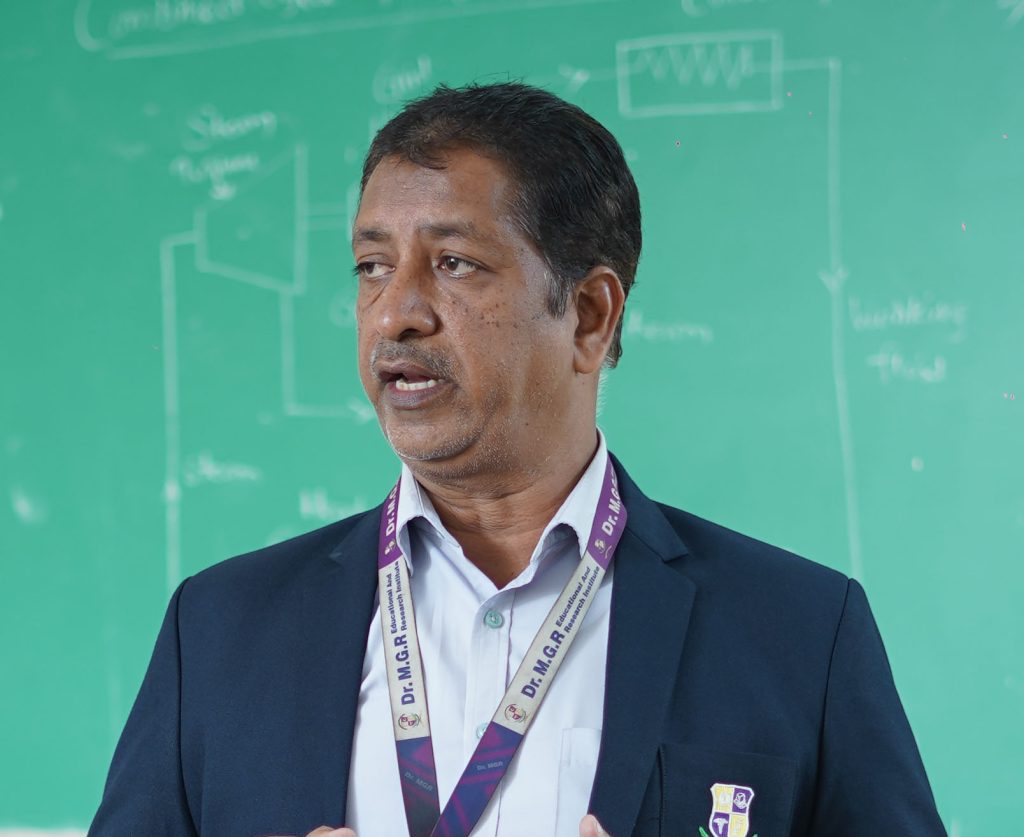
Dr. Ananthan T.V.
M.E, Ph.D
HoD's Desk
A Message
Warm Greetings!!!
Established in 2020, the Department of Artificial Intelligence has rapidly grown into a vibrant centre for academic excellence, research and innovation. Our mission is to prepare students to thrive in a technology-driven world where Artificial Intelligence plays a transformative role across industries and society.
The department focuses on building strong foundational knowledge in Artificial Intelligence while nurturing analytical thinking, creativity and problem-solving skills. Our curriculum integrates theory with hands-on learning to ensure students are industry-ready and capable of addressing real-world challenges. Core areas include Machine Learning, Deep Learning, Natural Language Processing, Computer Vision, Generative AI, Data Science, and Intelligent Automation.
Supported by highly qualified and research-oriented faculty, the department promotes a strong culture of innovation through research publications, funded projects, patents and consultancy initiatives. We emphasize interdisciplinary research and encourage students to explore impactful AI applications.
State-of-the-art laboratories, advanced computing facilities, internships, industry collaborations, hackathons and technical workshops provide practical exposure essential for employability, entrepreneurship and higher studies. The curriculum is regularly updated to align with global AI trends and industry requirements, supported by academic collaborations and MoUs with reputed organizations.
As AI continues to revolutionize healthcare, finance, smart infrastructure, robotics and cyber security, our department remains committed to nurturing ethical, skilled and visionary AI professionals who will contribute meaningfully to society and national development.
Research & Development
Research in Artificial Intelligence aims to advance knowledge in intelligent systems, data-driven decision-making, and algorithmic innovation. It tackles complex, interdisciplinary challenges to develop impactful AI models and data solutions that address real-world problems, meeting the evolving needs of industry and society.
Thrust Areas Of Research
- Artificial Intelligence & Machine Learning (AI & ML)
- Data Science & Big Data Analytics
- Image Processing & Computer Vision
- IoT & Human-Computer Interaction (HCI)
- Cryptography & Security
- Algorithms and Complexity Theory
- Computer Graphics and Visualization
Placed
Compaines Visited
Studies
Salary Package
Our Recruiters